How a hospital or clinic can run registration, OPD, wards and ICU, theatres, lab, radiology, pharmacy, billing and insurance, the patient portal and its specialties on one patient record in Odoo 19 and 20.
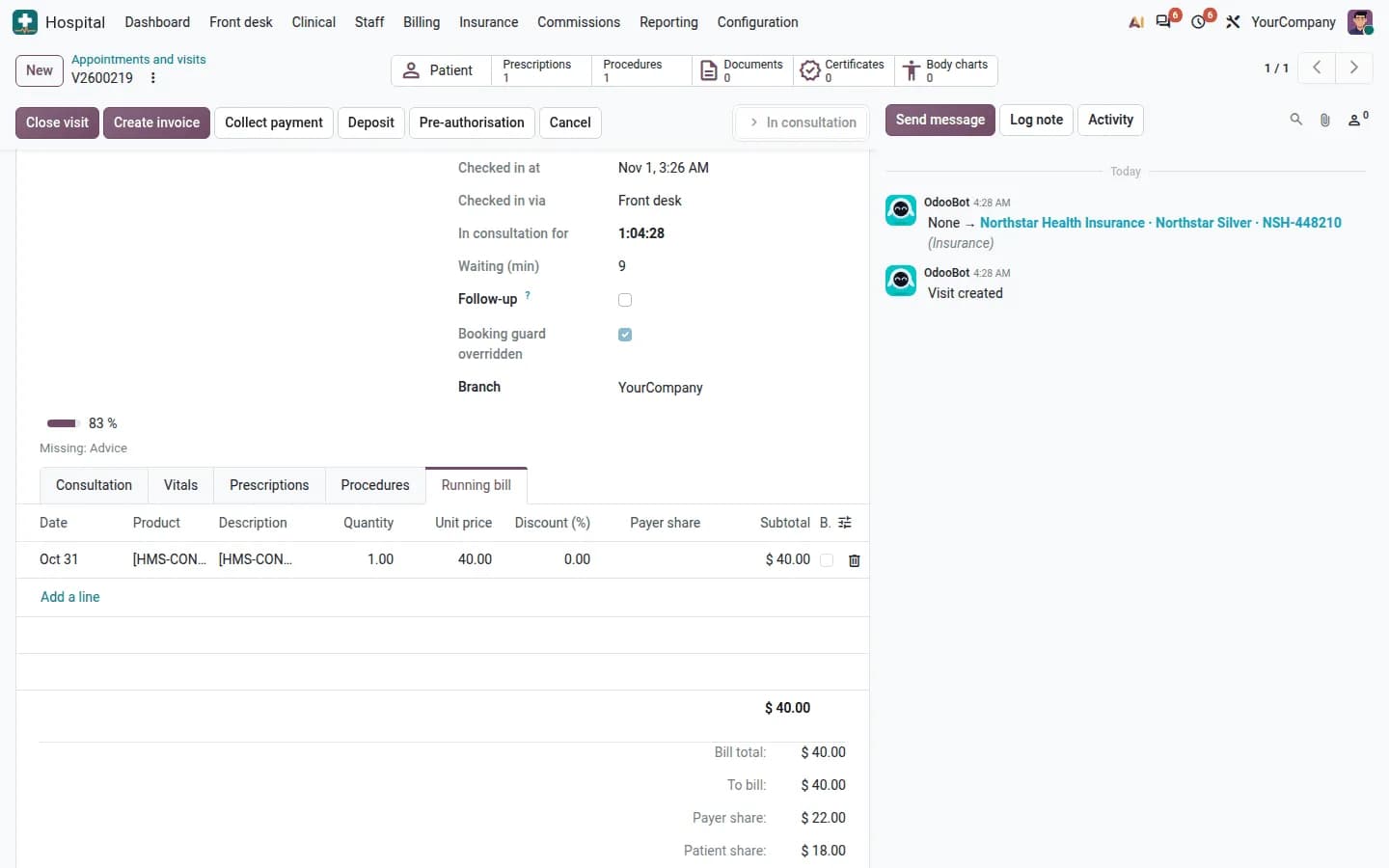
- Every department writes on the same patient and visit, so lab, imaging, pharmacy, surgery and ward charges land on one running bill.
- Safety checks are deterministic and explained: NEWS2, allergy and interaction checks, critical lab values and theatre checklists.
- Install the whole family at once, or start with the base app and add departments and specialties later.
Most hospitals run on a patchwork. The front desk has a booking tool, the lab has its own system, the pharmacy has a billing counter, the wards use paper charts and the accounts team rebuilds every bill from all of them. Each handover is a place where a charge goes missing, a result waits on the wrong desk or an allergy is not seen in time.
The Viyug hospital family puts every department on the same patient and the same visit in Odoo. It is a set of apps you can install one by one, or all together with the Hospital Management All-in-One app, which installs 26 of them with role dashboards for every department.
Front desk and OPD
A patient is registered once, with an MRN, a duplicate check, a barcode card and a wristband. From there, the base app runs the out-patient department:
- OPD appointments per physician and department, with a guard against overbooking.
- A token queue with QR self check-in and a waiting-room TV screen that calls the next patient.
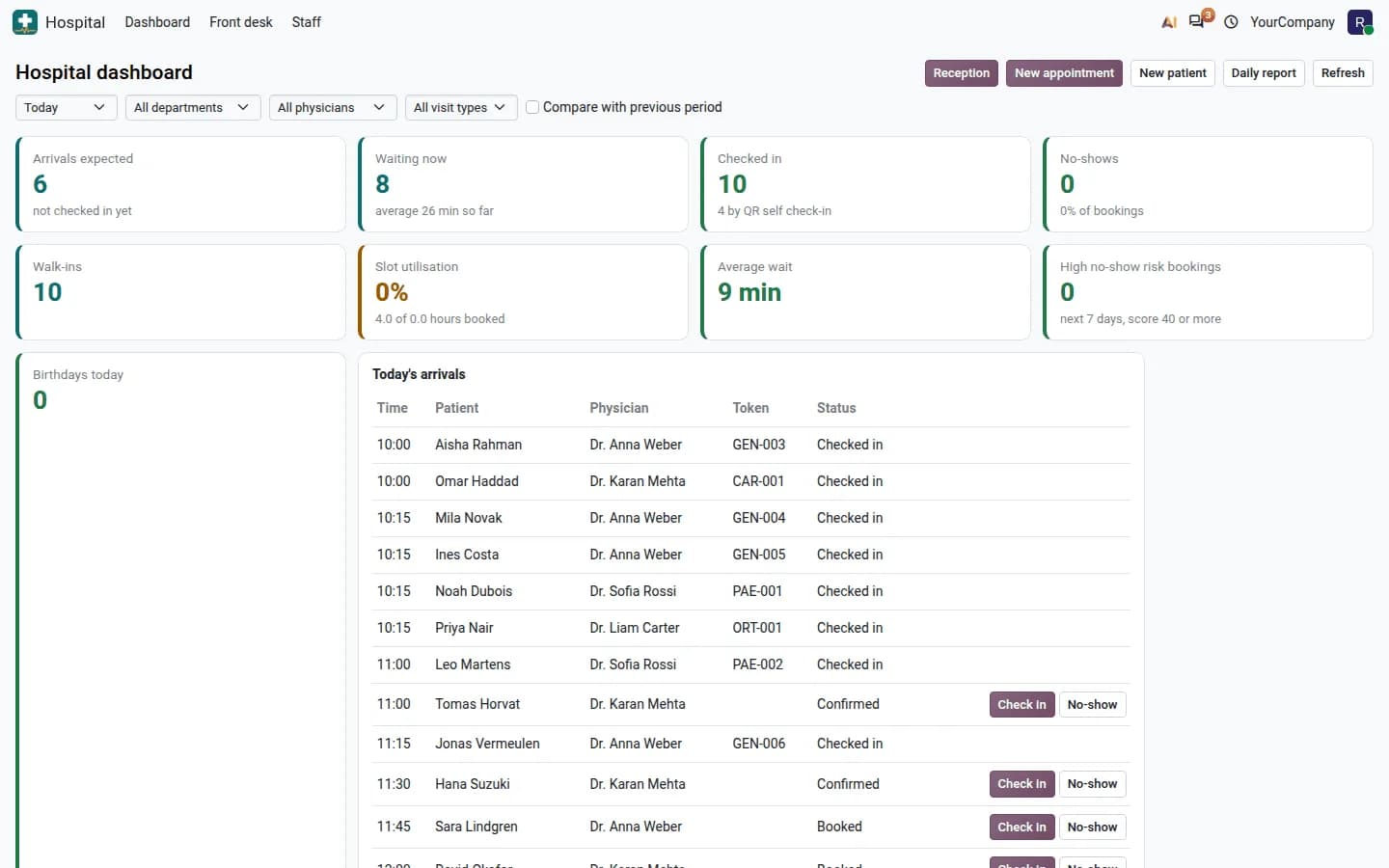
- A reception dashboard with expected arrivals, people waiting, average wait, walk-ins and no-shows.
- Branches, physicians with working hours, departments and medical representatives.
The consultation
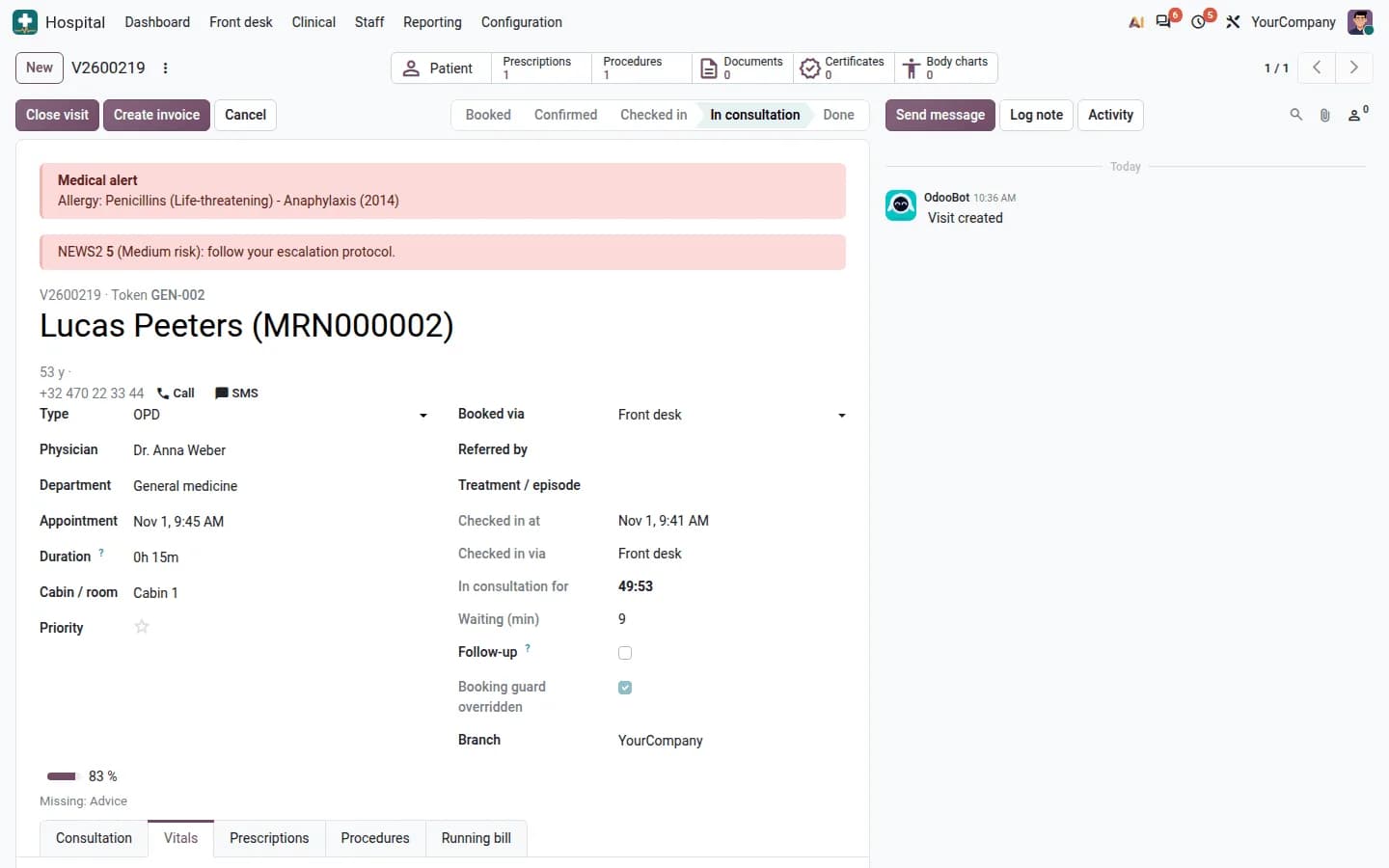
The doctor works on one visit record. Vitals give the BMI and the NEWS2 early-warning score, the patient's allergies and problem list are on screen, and diagnoses are coded in ICD-10. Prescriptions are checked against the allergies and carry a QR code that the pharmacy or the patient can verify. Procedures, recurring procedures, certificates, consent forms with an electronic signature, body charts, a webcam photo and patient documents with preview all sit on the same visit.
Sensitive records are limited to the care team. Anyone else has to break the glass with a reason, and every opening is written to an access log.
Laboratory and radiology
- Laboratory (LIS): requests from OPD and IPD visits, a LOINC test catalogue with reference ranges by age and sex, panels and calculated tests such as eGFR and LDL, specimen barcode labels, collection centres and home collection, abnormal and critical flags, delta checks, reflex tests, pathologist verification, turnaround times, internal QC with Levey-Jennings charts and Westgard rules, and analyzer CSV import.
- Radiology (RIS): imaging requests, a study catalogue for X-ray, CT, MRI, ultrasound, mammography and nuclear medicine, rooms and slots, structured reports with BI-RADS, Lung-RADS and TI-RADS, radiologist sign-off, critical findings, peer review, a contrast safety checklist, a radiation dose log and a DICOMweb link to your PACS with an OHIF or Weasis viewer.
- Both offer online slot booking, a bill sheet and results in the patient portal.
Pharmacy and the counter
The pharmacy dispenses from prescriptions in full or in part. Before anything leaves the shelf, it checks drug interactions, allergies, duplicate therapy and the maximum dose, and shows the source of each finding. Lots are suggested first-expiry-first-out, with lot and expiry on the invoice lines, near-expiry alerts, reorder suggestions, a controlled drug register with a witness, generic substitution, ward indents and returns, and medication labels.
The Pharmacy POS add-on brings the same checks to the Odoo point of sale: confirmed prescriptions load into the order, an override needs a reason, and consultations, lab tests and imaging sold at the counter become appointments and requests.
Wards, ICU and theatres
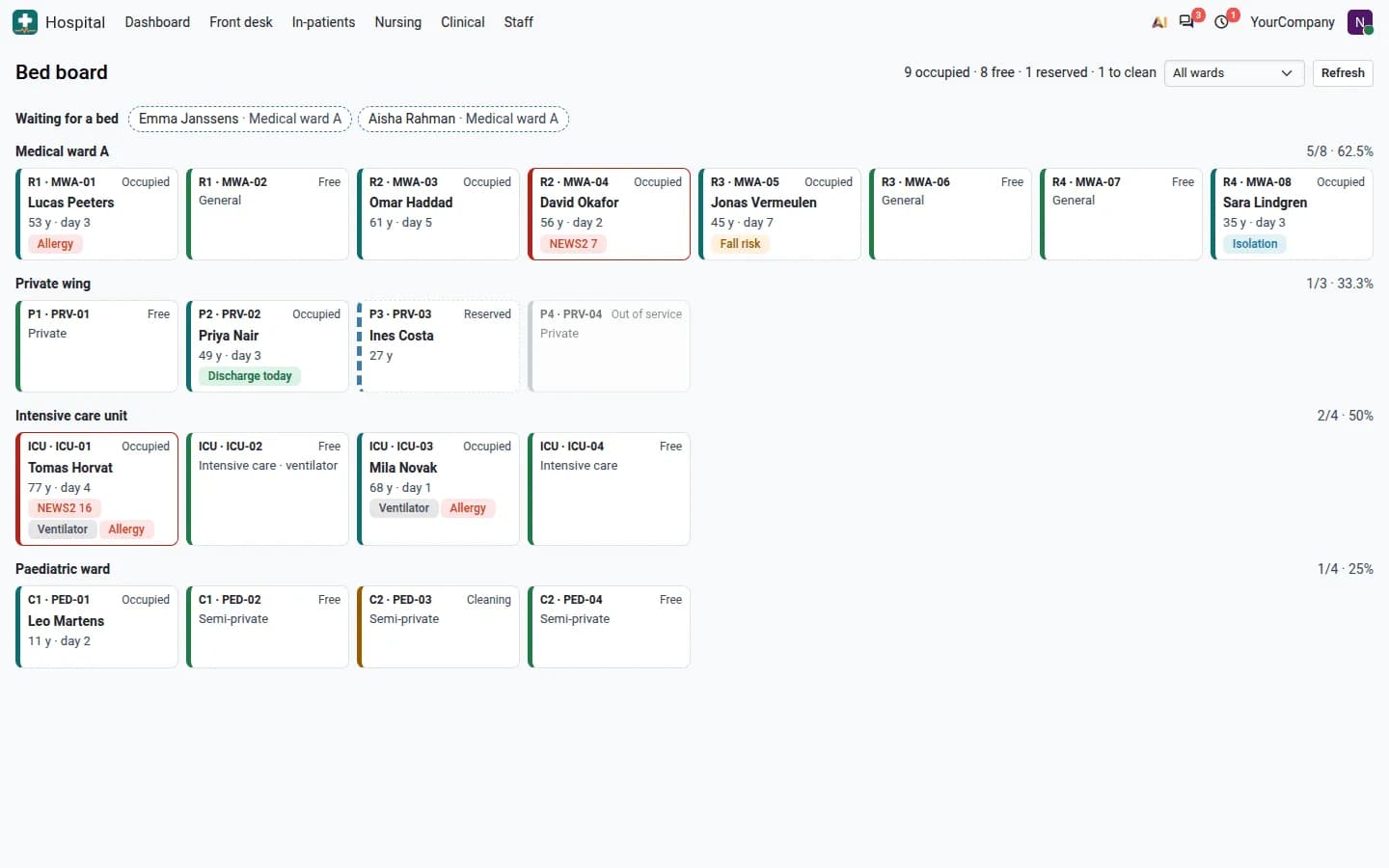
- In-patients (IPD): admission requests, a live bed board with drag-and-drop transfers, bed classes with bed-day and transfer charges, IPD packages, deposits and a running bill, care plans, eMAR with wristband and barcode scan, intake and output charts, NEWS2 escalation, Morse and Braden scores, SBAR handover, and a discharge summary.
- ICU: a flowsheet with GCS, MAP and RASS, a ventilation log, and APACHE II and SOFA scores.
- Surgery: operation theatre booking with a conflict guard and roster, the surgical safety checklist (sign in, time out, sign out) as a gate, an anaesthesia record with ASA class, instrument and sponge counts, an implant log with UDI scan, consumables from stock, and transplant and procedure waiting lists.
Billing, insurance and claims
Every department charges the same visit or stay, so the bill is complete when the patient leaves. The billing app adds the revenue cycle: insurance companies, TPAs and corporate payers, plans with coverage, co-pay and deductible per category, pre-authorisation, invoices split between the patient and the payer, claims with checklists, denial reasons and resubmission, remittance import, packages and subscriptions, cashier shifts with a cash count, advance deposits, discount approval, doctor and referral commissions, and AR ageing.
Specialties you switch on when you need them
Each specialty is its own app and adds its records to the patient and its widgets to the dashboards:
- Emergency and ambulance: triage board with target times, NEWS2 on arrival, medico-legal register, mass-casualty registration and ambulances on Odoo Fleet.
- Women's health and IVF: antenatal schedule, ultrasound biometry, partograph, delivery and newborn records; treatment cycles, embryology with blastocyst grading, cryo storage and donors.
- Paediatrics: growth charts with z-scores, immunisation schedules, vaccination from stock and the AEFI register.
- Cardiology: ECG with QTc, echo, Holter, treadmill, a cardiac device registry, CHA2DS2-VASc and HAS-BLED, and an INR clinic.
- Oncology: TNM staging, chemotherapy protocols with BSA and AUC dosing, cumulative dose limits, CTCAE toxicities, radiotherapy and the tumour board.
- Nephrology and dialysis: sessions with Kt/V and URR, chairs and machines scheduled without conflicts, vascular access.
- Blood bank, diet and nutrition, physiotherapy, psychiatry, ophthalmology, ENT and an aesthetic clinic.
Patients online
The patient portal lets patients book by doctor or department, pay in advance, reschedule, and see their appointments, prescriptions, results with a doctor-approved explanation, invoices and documents, with family accounts. Telemedicine adds video consultations on Jitsi, Odoo Discuss, Zoom or Microsoft Teams with a virtual waiting room. With the WhatsApp add-on, patients receive booking confirmations, reminders and a notice when results or medicines are ready, never the results themselves.
AI with guardrails
The AI app drafts SOAP notes, patient and discharge summaries and aftercare instructions, suggests ICD-10 codes from your own code table, answers questions about your data in plain language, and forecasts no-shows and bed occupancy. A clinical draft is saved only when a clinician signs it. It uses your own AI provider key, patient data is off by default, and requests are audited.
Open standards and India's ABDM
The interoperability app exposes a FHIR R4 API, sends lab orders and receives results over HL7 v2, writes DICOM modality worklist files and imports patients and history from your old system by CSV. Hospitals in India can add the ABDM app for ABHA numbers, Scan & Share registration, care contexts and consent-based exchange of FHIR records; it needs your own NHA registration.
Try it on a live demo
The demo is a fictional hospital, Riverside General Hospital, with the whole family installed on Odoo 20 Enterprise and demo data in every department: the OPD queue, emergency, wards and ICU, theatres, lab, radiology, pharmacy, blood bank, billing and the specialties. It opens without a login as the hospital manager, on the hospital dashboard, at hospital-demo.viyuginfotech.com/try-demo.
Install all of it, or start small
The family runs on Odoo 19 and 20, Community and Enterprise; the base app needs only Community apps, and the base app is translated into Arabic, German, Spanish and French. A clinic can start with the base app and add the lab or the pharmacy later; a hospital can install the All-in-One app and switch on the departments it runs.
If you want help with the setup, the test catalogue and price lists, migrating patients from your current system or connecting your analyzers and PACS, tell us what you run today.
Frequently asked questions
Which Odoo versions and editions does it support?
Odoo 19 and 20, Community and Enterprise. The base app needs only Community apps (Invoicing, Employees, Contacts and Portal).
Do I have to buy the whole family?
No. Each app is sold on its own on the Odoo App Store. The Hospital Management All-in-One app installs 26 of them together; the Dental bridge, WhatsApp and India's ABDM app are installed separately because they need another app or are country-specific.
Does the AI write in the medical record by itself?
No. The AI app only prepares drafts and suggestions. A clinical draft is saved when a clinician signs it, it uses your own AI provider key, and patient data is off by default.
Can it connect to our lab analyzers and PACS?
Yes. The lab app imports analyzer results by CSV, the interoperability app sends and receives HL7 v2 lab messages and writes DICOM modality worklist files, and the radiology app links to a DICOMweb PACS with an OHIF or Weasis viewer.
Can I try it before buying?
Yes. The live demo opens without a login as the manager of a demo hospital with the whole family installed on Odoo 20 Enterprise and demo data in every department.
Can you help us set it up?
Yes. We can configure departments, physicians, wards and price lists, import your patients from your current system and connect your devices. Tell us what you run today on the contact page.